
Walking Wine Tour
Three Wine Bars with Walking Pigeon Wine Tours

As I was scrolling through Instagram one day, I cam across an add for Walking Pigeon Wine Tours who were hosting a 3-hour walking tour to three different bottle shops. Since this event was billed as “East Side” I was all in! In fact, the final stop was a little over a kilometer from home (and I’d been there before,) so how could I pass that up! The first two wine bars were new to me, so I was eager to try them out.
Our tour guide was Jayden Robins, a fellow graduate of George Brown College’s WSET Level 2 program. I was fun to chat about the program, as well as some of our favourite wines. Jayden came prepared with a knapsack full of water and snacks (which came in handy by the time we got to our final stop) and provided us with a helpful tasting sheet.
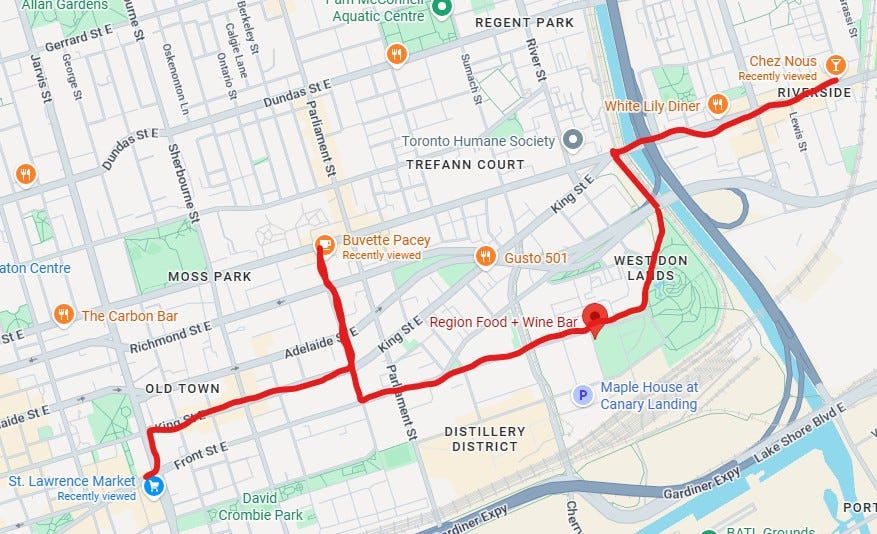
Stop 1: Buvette Pacey
We met at the St. Lawrence Market on Front St. E. and made our way eastward along King Street then over to Buvette Pacey on Berkley St., just south of Queen. We were hosted by the owner, Shabri Kapoor, who has a love of interesting wines from around the world, both conventional and natural (sadly, the shop’s namesake, Pacey, wasn’t there that evening.) She poured us the following two wines:
Wine 1: Meinklang, 2025 Grüner Veltliner, Burgenland, Austria, 11% ABV.
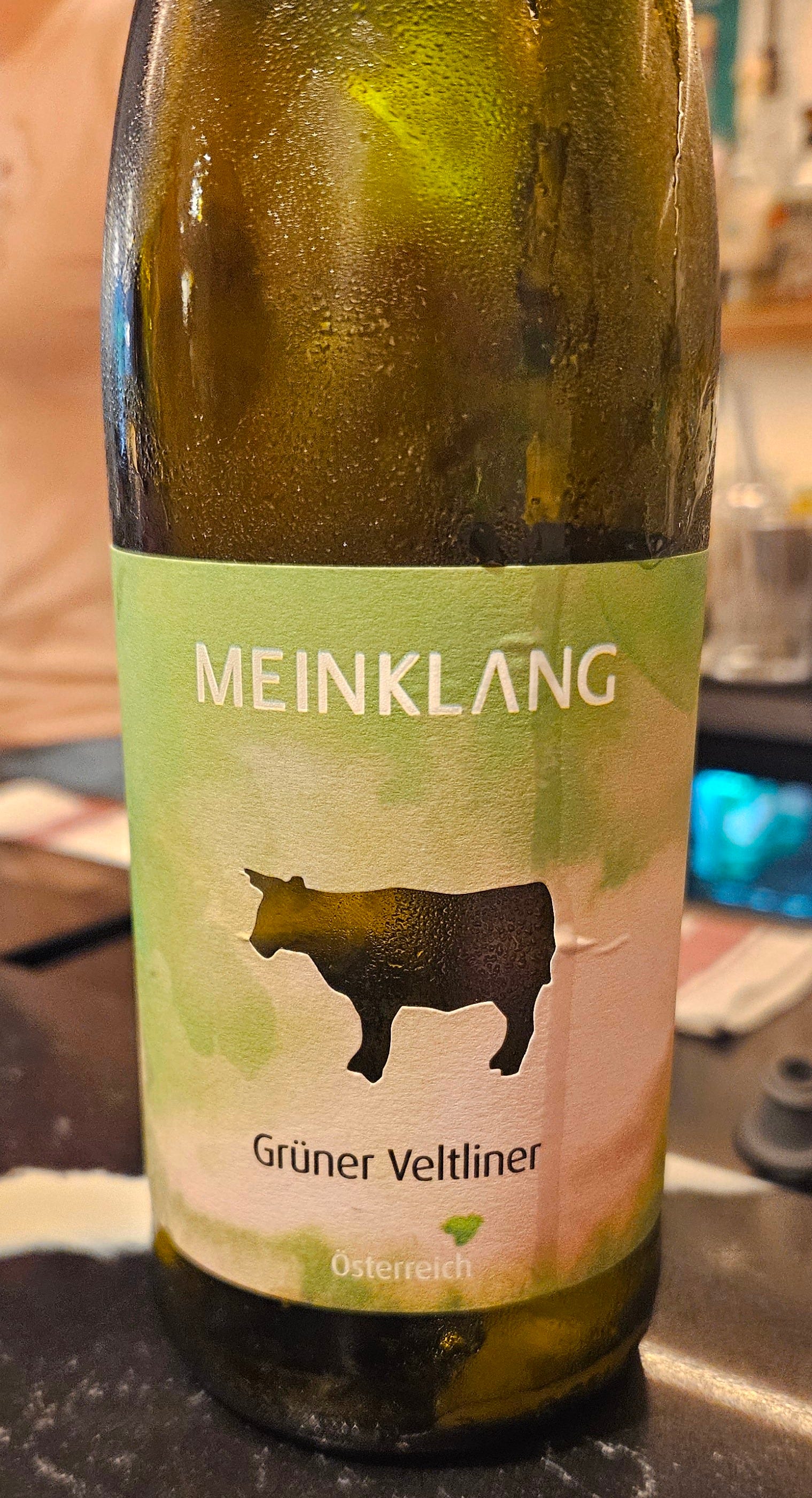
I’ve had and enjoyed this one before. Pale lemon in colour with medium intensity notes of citrus (peel and pith) on the nose. Dry on the palate with medium intensity where all those lovely citrus and some green apple flavours come through. Flavour-wise, it’s like a cross between Riesling and Sauvignon Blanc, so if you like either of those varieties, you’ll like this.
The second wine was a “Pét-Nat” from Australia. Before I describe it, here’s a little primer on three (of many different) ways of making sparkling wine:
Traditional Method: Champagne, Cava, Crémant, Franciacorta, and Cap Classique, to name a few. This is where the second fermentation—what creates the bubbles—happens in the bottle. These sparkling wines often have yeast-y, toasty, or brioche-like aromas to them.
Charmat Method: Also known as the tank method, Prosecco and many other regions make their sparkling wine this way where the second fermentation (i.e., the bubbles) happens in a stainless steel tank, then it’s bottled under pressure, trapping the bubbles in the bottle. It’s less time consuming and less expensive than the traditional method and tend to be fresher (i.e., less yeast-y.)
Pét-Nat: The full name for it is pétillant naturel (French for naturally sparkling) and it’s one of the oldest methods of making wine (not just sparkling wine.) It’s also sometimes called méthode ancestrale (ancestral method.) The wine is bottled before fermentation is complete, so the carbon dioxide that is a by-product of the fermentation process (using naturally occurring yeasts) is trapped inside the bottle. The resulting wine tends to be cloudy, sometimes (but not always) a bit funky, only mildly bubbly, and can vary greatly from one batch or vintage to the next. They have varying levels of alcohol, and sometimes the winemaker doesn’t even know how the finished product will turn out.
Wine 2: Wild Man Wine, Astro Bunny Pét-Nat 2024, Australia, 11.5% ABV


I’ve only had a few Pét-Nats before, and they are like a mysterious party in a bottle! You never know what you’re going to get. This one is a blend of Fiano, Malvasia Bianca, Pecorino, Nero d’Avola, and Canada Muscat from Riverland and McLaren Vale in South Australia. It’s a beautiful, slightly hazy, pinky-orange colour reminiscent of pink grapefruit juice. It actually smells and tastes a bit like sparkling grapefruit juice, but I wonder how much of that is because that’s what it looks like to me (am I being influenced by the appearance?) It’s mildly bubbly, almost like San Pellegrino (as opposed to club soda.) There’s also a bit of stone fruit (nectarine.) It was very clean, not funky like many Pét-Nats. This is a perfect patio sipper, or as an alternative to a mimosa with brunch.
Since she had an open bottle of Cava on hand, Shabri sent us off with a special “Kir Royale” which is sparkling wine with a splash of Crème de Cassis liqueur. This is a typical aperitif served in France. An alternative made with still white wine is simply called “Kir.”
Stop 2: Region Food + Wine Bar
Our next stop was a 15-min/1.2km walk south then east into the Canary District. This area began development for the PanAm Games in 2015 and is now a well-established neighbourhood just a block east of the old Distillery District.
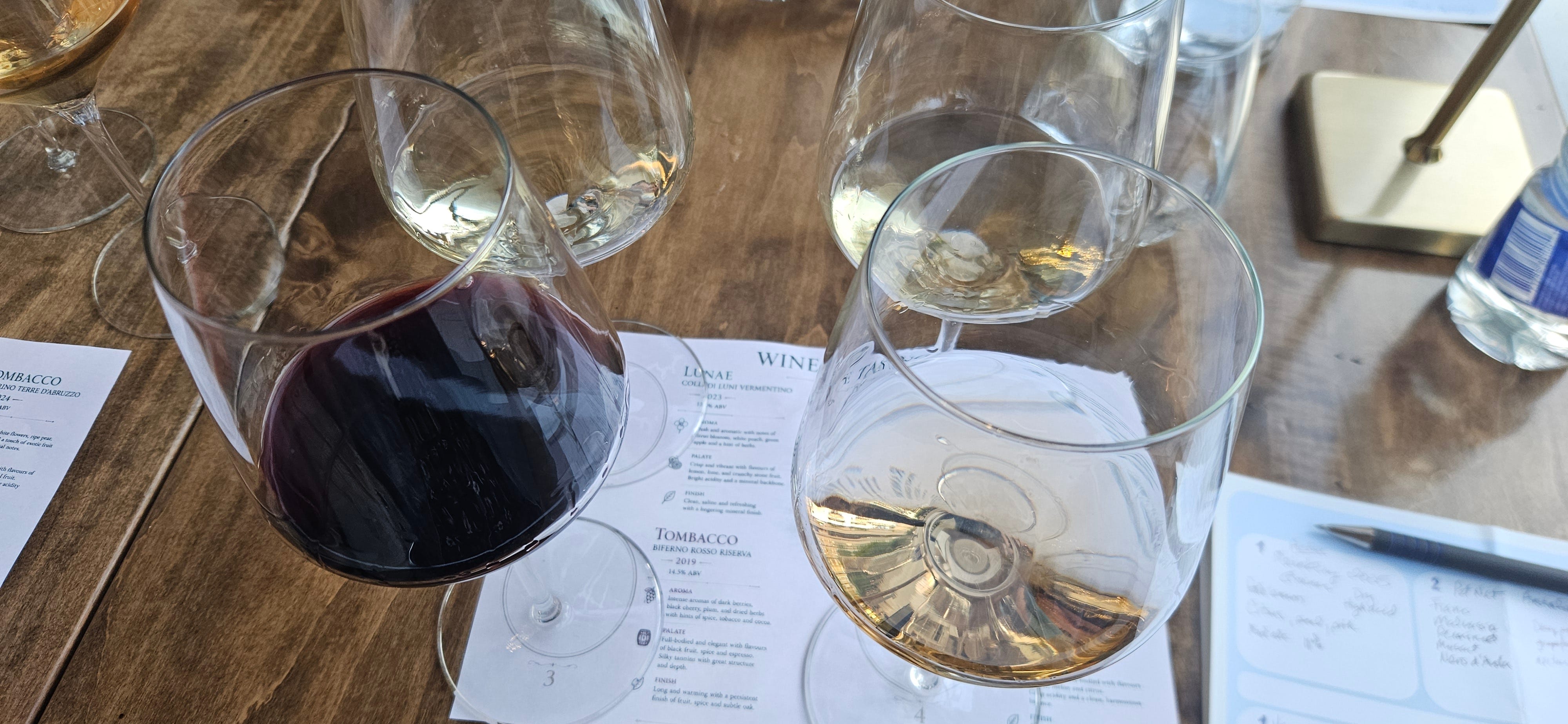
This was a different type of tasting from the previous one as we were tasting all Italian wines from indigenous grapes. Italy has thousands of indigenous grape varieties, so it was interesting to try something new and different. The Sommelier, Dries Caems, poured four wines for us: two whites, one red, and one orange wine. I was thankful for the tasting sheet provided so that I didn’t have to take as many notes myself!
Lunae, Colli di Luni, 2023 Vermentino DOC, Liguria, Italy, 13% ABV
Tombacco, 2024 Pecorino Terre D’Abruzzo IGT, 13% ABV*
Tombacco, 2019 Biferno Rosso Riserva DOC, Abruzzo, Italy, 14.5% ABV
Ramoro, 2023 Pinot Grigio, Abruzzo, Italy, 12.5% ABV
*I couldn’t find a link to this exact bottle, so the link provided is to the winery itself. They have another one called Terre de Chieti, which is also from the Abruzzo region, so maybe the name has changed?
Italian wine classifications have several levels. The ones you’ll most likely see on a bottle are DOC, DOCG, and IGT.
DOC: Denominazione di Origine Controllata — this is a basic quality standard and guarantee of authenticity for wines coming from a specific region. It specifies which grapes can be grown, and how and where it can be vinified and bottled.
DOCG: Denominazione di Origine Controllata e Garantita — the highest level of quality, guaranteed with lab testing and tasting panels.
IGT: Indicazione Geografica Tipica — this is a newer classification that gives winemakers and grape growers more freedom in which grape varieties can be planted and vinified, yet still guarantees the quality of the wine. For example, wines made from Cabernet Sauvignon in Tuscany (not an indigenous grape normally permitted in the region) would be labeled IGT.
Vermentino: this was a lovely, crisp and fresh aromatic white with citrus, peach, and some herbal notes (I got some anise/fennel.)
Pecorino: Most people know this name because of the cheese, but the grape produces an aromatic, medium-to-high acid white wine with aromas of pear, citrus and tropical fruit.
Biferno: This was not a wine I was familiar with, so I was eager to try it. It’s a blend of 80% Montepulciano d’Abruzzo and 20% Aglianico, both indigenous Italian grapes. Deep ruby in colour, it had tons of aromas and flavours of dark fruit (sour black cherry,) plums, cocoa, and tobacco.
Pinot Grigio: Rather than making a blanket statement like, “I don’t like Pinot Grigio,” I’ve started to say, “I haven’t yet had a Pinot Grigio that I’ve liked.” Well, I can’t actually say that anymore because this one was fantastic (I even bought a bottle to take home.) This is a skin contact or orange wine, that’s a very pale salmon in colour. You’d almost mistake it for a rosé. It had bright acidity and a ton of flavour (green apple, pear, and melon) atypical of the Pinot Grigios I’ve had in the past. One of my tasting companions suggested that this would be the perfect wine to serve with pork and a caramelized apple compote. That sounds so good, that I might have to make that!
Another fun coincidence, Dries (the Somm) and I wrote our WSET Level 3 exam at George Brown on the same day (and we are both still waiting on results.)
Stop 3: Chez Nous Wine Bar
Next, we had a 20-min / 1.7K walk up to Queen Street, then east over the Don River into the neighbourhood known as Riverside, which is adjacent to Leslieville. The wine bar was hopping on Friday night and we were seated outside, which was perfect on a warm (almost) summer evening. Our host was the owner, Laura Carr, who poured us three lovely Ontario wines (two of which I’d tasted before.)
Westcott Vineyards, Violette Sparkling Brut, VQA Ontario, 12.4% ABV
Rosehall Run, Acid Head 2024 Riesling, VQA Twenty Mile Bench, Niagara, ON
MW Cellars, 2024 Gamay, VQA Niagara-on-the-Lake, ON
Cousin Jano and I have visited both Westcott and Rosehall Run and have tried several of their wines, including the Violette Sparkling and the Acid Head Riesling. The MW Cellars Gamay was new to me.


Violette: this is an easy-drinking sparkling wine made in the Charmat (tank) method. It’s fresh, approachable, dry, and full of citrus, apples, and pears. It’s available at the LCBO for $26.95.
Acid Head: the art work on this bottle is spectacular, and the wine really lives up to its name. It’s a super-high acid, very dry Riesling, that will pucker your cheeks (in a good way) and get your tastebuds going to enjoy the lemon-lime flavours. Interestingly, Rosehall Run is based in Prince Edward County, but the grapes for this wine come from the Twenty Mile Bench in Niagara. This is quite common in PEC, where certain grape varieties don’t grow as well there, so they source grapes from Niagara.
Gamay: MW Winery in Niagara-on-the-Lake is not one that was familiar to me, and Gamay isn’t a grape I’ve tasted much until quite recently. It was hard to tell in the dark (it was past 9PM by the time we sat down to taste) but it appeared to be a pale ruby in colour, typical of Gamay. The first thing I noticed on the nose was aromas of dill, which is often associated with ageing in new American oak. Behind that were the juicy notes of red berries, making this light-bodied wine approachable, and perfect to serve slightly chilled.
Summary
After nine wines and one Kir Royale, I was ready to call it a night. Keep in mind, these were 2oz pours (and I didn’t finish all my samples) and we walked a lot over the 3+ hours. I was hardly wasted, but certainly glad that I was only a short streetcar ride from home.
I would absolutely recommend Jayden and his Walking Pigeon Wine Tours for anyone who wants to try a bunch of different wines in different settings without having to drive to Niagara or Prince Edward County, or fly to Italy, Austria, or Australia (though that does sound delightful.)
Next week, I’ll have a bit more wine content because I’m currently cat sitting in Prince Edward County and hope to try a few new things (and some old favourites) while I’m here.
Until then, cheers!